The Foundation Principle: Why the Clothes Nobody Sees Define Everything They Do
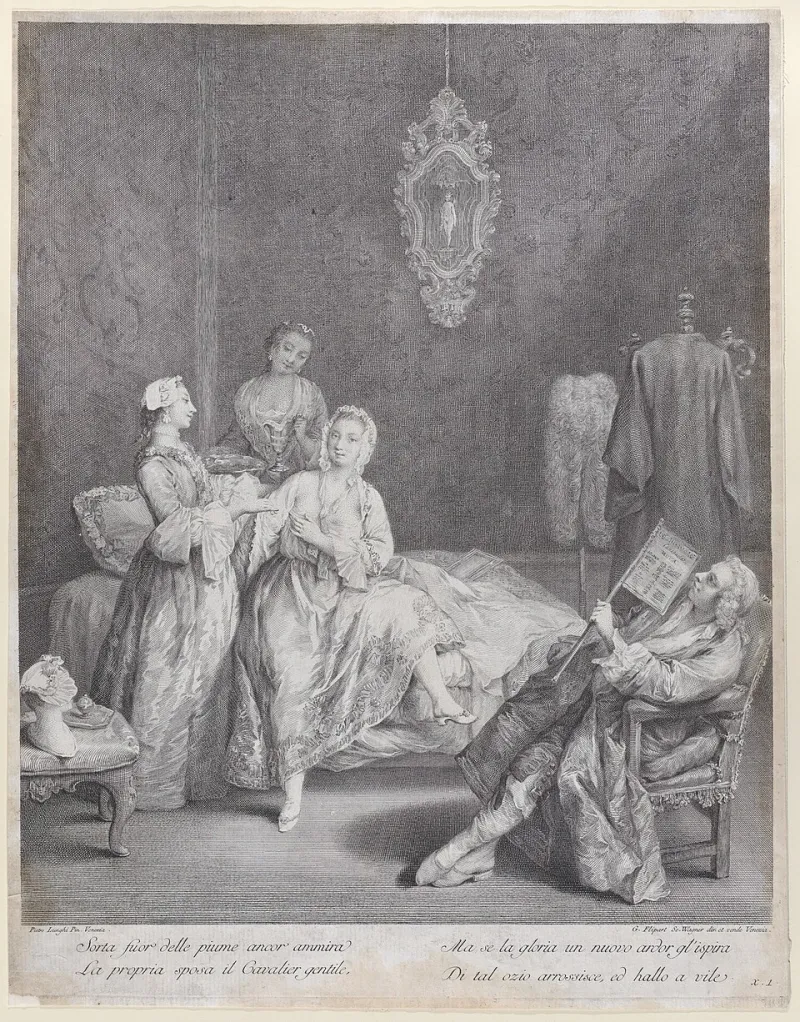
Photo: Charles Joseph Flipart, CC0, via Wikimedia Commons
There is a particular kind of confidence that photographs poorly. It does not arrive with a striking silhouette or a carefully chosen accessory. It settles into the body quietly — in the way someone stands at a reception, the ease with which they move through a crowded room, the absence of adjustment and self-consciousness that marks a person who is, at their most fundamental level, comfortable in what they are wearing. That confidence, more often than not, begins with what no one in that room will ever see.
The fashion industry has long celebrated the visible. Runway coverage focuses on the outermost layer. Editorial spreads are built around statement pieces. And while there is genuine artistry in all of that, it has created a persistent blind spot: the foundational garments — the intimate pieces, the base layers, the underwear — are consistently treated as afterthoughts, practical necessities that exist outside the domain of real style. This is a significant error in thinking.
The Architecture Beneath the Architecture
Designers understand something that most consumers do not: a garment performs only as well as what supports it. A beautifully cut blazer reads differently on a body that is at ease versus one that is quietly managing discomfort. A fluid silk blouse tells its own story, but that story changes entirely depending on what lies beneath it. The foundation is not separate from the style — it is the condition that makes genuine style possible.
This is not merely a technical observation about fit and construction, though fit and construction are certainly part of it. It is a psychological one. When the most intimate layer of your dressing is chosen with care — when it is comfortable, well-made, and suited to your actual body rather than an idealized one — something shifts in how you inhabit your clothes. You stop managing your outfit and begin simply wearing it. The distinction is enormous.
Investment in foundational pieces is one of the more counterintuitive recommendations in contemporary styling, precisely because the return is invisible to everyone but you. And yet that invisibility is exactly the point. The confidence generated by a well-fitting, quality undergarment is not performed for an audience. It is structural. It belongs to you entirely.
The Psychology of the Private Choice
There is something worth examining in the relationship between private choices and public presence. The decisions we make when no one is watching — the quality we insist upon for ourselves even when it will go unwitnessed — are among the most telling expressions of self-regard. A woman who dresses her foundation with the same intention she brings to her outerwear is communicating something important to herself about her own worth. That communication is not incidental to style. It is foundational to it in the deepest sense.
American culture has a complicated relationship with this idea. There is a long tradition of practicality that treats intimate apparel as purely functional — something to be purchased efficiently, replaced reluctantly, and thought about as little as possible. This utilitarian approach is understandable, but it comes at a cost. When the base layer is uncomfortable, ill-fitting, or simply wrong for the garment above it, the entire outfit becomes a negotiation. You are no longer dressed. You are managing.
Contrast this with the approach taken in European fashion traditions, where foundational pieces have historically been treated with the same seriousness as any other element of the wardrobe. The concept of the dessous — the French understanding of intimate apparel as an extension of personal elegance rather than a departure from it — reflects a philosophy in which the private and the public are continuous, not separate. What you wear beneath your clothes is part of the same story.
Choosing Foundations With Intention
Approaching foundational pieces with genuine intention means asking a different set of questions than you might bring to a coat or a dress. The relevant criteria are not primarily aesthetic, though aesthetics matter. They are tactile, structural, and deeply personal.
Does this garment support the way my body actually moves? Does it remain comfortable across a full day — through a commute, a meeting, an evening out — or does it require management? Does it work with the clothes I wear most often, or does it create friction with them? Is the quality sufficient that it will hold its shape and its comfort over time, or will it require replacement before the season is out?
These are the questions a designer asks about any piece in a considered wardrobe. The fact that they apply equally to the pieces beneath the visible ones is not a coincidence — it reflects the understanding that style is not a surface phenomenon. It is systemic. Every layer participates.
Material quality deserves particular attention here. The difference between a foundational piece made from considered materials — natural fibers, thoughtful construction, appropriate structure — and one made purely to a price point is felt immediately and continuously. It is the kind of difference that compounds across a day, a week, a season. Comfort is not a luxury in this context. It is a prerequisite for the kind of ease that genuine style requires.
The Invisible Made Visible
There is a reason that the most consistently well-dressed people — those whose style appears effortless rather than labored — tend to be those who have thought carefully about every layer of their wardrobe. Effortlessness is not accidental. It is the result of a system in which every element, visible and invisible, has been chosen with care and functions in concert with the others.
When the foundation is right, the visible layers are freed to do their work. A trouser falls correctly. A blouse moves without constraint. A dress sits as it was designed to sit. The garment expresses itself fully because nothing beneath it is working against it. This is what designers mean when they speak about clothes that "work" — they are describing a coherence that runs through every layer, including the ones that never appear.
Dressing with intention, in the fullest sense, means extending that intention all the way down. It means refusing the cultural shorthand that treats foundational pieces as outside the domain of real style. It means recognizing that the confidence you carry into a room was assembled, in part, in private — in the choices you made when no one was watching, for yourself alone.
That confidence is the most authentic kind. And it begins, always, at the foundation.