The Perennial Wardrobe: Transitioning Between Seasons Without Losing Your Style Thread

Photo: woman organizing seasonal wardrobe closet layering transitional fashion autumn, via thegoodpositive.com
There is a particular kind of anxiety that arrives in early September and again in March: the realization that the season is shifting, and the wardrobe must somehow follow. For many, this moment prompts a flurry of shopping, a hasty departure of summer dresses or winter coats, and a vague sense that starting fresh is the only viable path forward.
It is not.
The most stylistically coherent people I have observed—those whose wardrobes feel genuinely personal rather than seasonally reactive—do not reinvent themselves with the calendar. They refine. They layer. They find the through-line that connects a February coat to an August blouse and treat that line as something worth protecting.
Seasonal editing, done well, is not about clearing out and starting over. It is about understanding which pieces in your collection are truly perennial, which require strategic repositioning, and which have genuinely completed their tenure. The distinction matters enormously—not only for your finances, but for the coherence of your personal style.
The Myth of the Complete Seasonal Overhaul
American retail has long promoted the idea of the seasonal wardrobe reset. Fall collections arrive in August. Spring arrives in January. The implicit message is that what you wore last season is no longer adequate—that relevance requires replacement.
This is, at its core, a commercial narrative rather than a sartorial one.
The reality of a well-constructed wardrobe is that the majority of its pieces should function across multiple seasons with minimal adjustment. A beautifully cut silk blouse does not become irrelevant in October; it becomes an underlayer. A structured wool trouser worn with sandals in late summer becomes the anchor of a cold-weather ensemble by November. The garment has not changed. Only its context has.
When we approach seasonal transitions as opportunities for strategic reconfiguration rather than wholesale replacement, we begin to see the wardrobe as a living system—one that evolves continuously rather than resets abruptly.
Identifying Your Perennial Pieces
The foundation of any intelligent seasonal edit is an honest assessment of which items in your wardrobe are genuinely season-agnostic. These are pieces that, with minor styling adjustments, read appropriately across a broad temperature range and cultural context.
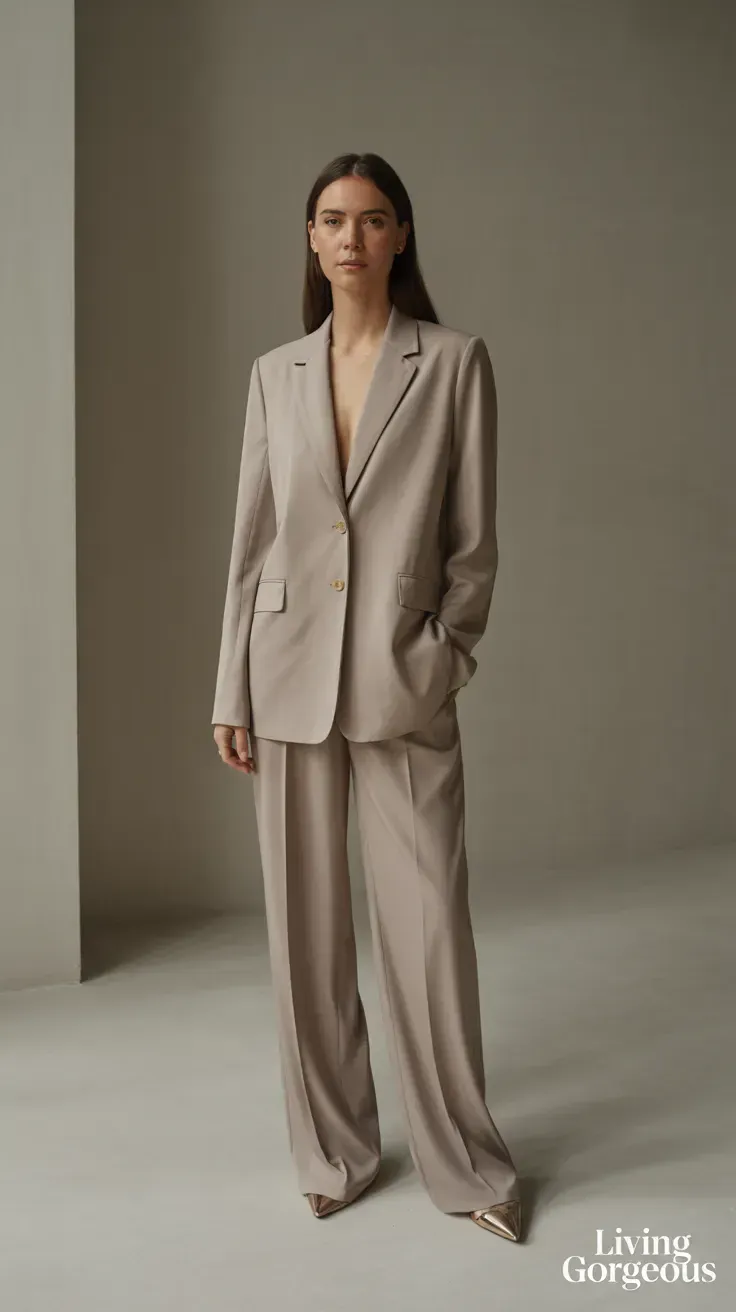
Certain silhouettes tend toward perenniality: the tailored blazer, the midi-length skirt, the well-proportioned shirt dress, the straight-leg trouser in a medium-weight fabric. What unites them is their structural neutrality—they do not announce a season. They accept layering without resistance. They move between contexts gracefully.
For each piece in your wardrobe, ask a simple question: Can this work in at least three of the four seasons with the right accompaniments? If the answer is yes, it belongs at the core of your collection. If the answer is no—if a garment is functionally limited to a narrow window of the year—it should be held to a higher standard of love and utility before it earns its place.
The Strategic Swap: What Actually Needs to Move
Once your perennial foundation is identified, the seasonal swap becomes a much more targeted exercise. Rather than rotating the entire wardrobe, you are managing a relatively small category of genuinely season-specific items: heavy outerwear, lightweight summer dresses with minimal layering potential, thick knitwear, and the like.
For these pieces, proper storage is as important as the swap itself. Folded knitwear stored flat in breathable cotton bags retains its shape and avoids the shoulder distortion that comes from hanging. Linen and cotton pieces stored with cedar discourage moths without the chemical residue of traditional deterrents. The care taken in storing a piece directly affects its longevity and its condition when it returns to active rotation.
Beyond storage, consider the concept of the transition capsule: a small, curated grouping of pieces that bridge the gap between seasons. In the American context, this is particularly relevant in regions where fall and spring are extended and genuinely variable—the Pacific Northwest, the mid-Atlantic states, much of the Midwest. A transition capsule might include a lightweight knit cardigan, a trench coat, a long-sleeved silk top, and a pair of ankle trousers. These pieces do not belong definitively to summer or winter. They belong to the in-between, and they are among the most versatile investments in any wardrobe.
Unexpected Layering as a Year-Round Strategy
Perhaps the most underutilized tool in seasonal dressing is the unexpected layer. American fashion culture tends toward literal interpretations of seasonal dressing—heavy fabrics in winter, light ones in summer—but the most interesting wardrobes resist this literalism.
A slip dress worn over a fitted turtleneck is not a compromise; it is a composition. A linen shirt worn beneath a structured vest in October extends the life of a summer staple without forcing it into an unsuitable context. These combinations require a certain willingness to experiment, but they also require a wardrobe with enough internal coherence that the pieces speak to one another across seasonal categories.
This is where the concept of a consistent personal palette becomes practically valuable. When your wardrobe operates within a defined color range—even a generous one—pieces from different seasons naturally harmonize. A summer blouse in warm ivory does not clash with a winter coat in camel. They belong to the same visual family, and layering them requires no special effort.
Repurposing With Intention
Seasonal editing also presents an opportunity to reconsider the function of existing pieces. A dress that felt too formal for summer may, belted over a turtleneck with knee-high boots, become a compelling autumn look. Wide-leg trousers that read as casual in July take on a different register in October when paired with a structured blazer and a pointed-toe flat.
This kind of repurposing is not a workaround. It is, in fact, the mark of a sophisticated relationship with clothing—one that sees the garment as a participant in a larger conversation rather than a fixed object with a single purpose.
At Suha Atiyeh, the belief that design serves longevity is central to how collections are conceived. A piece should not exhaust its relevance after a single season. It should offer new possibilities over time, rewarding the wearer who pays attention.
The Edit as a Ritual
Finally, it is worth reframing the seasonal transition itself—not as a chore or a commercial obligation, but as a genuine ritual of self-reflection. Twice a year, the wardrobe asks you to consider who you are now, what you actually reach for, and what no longer serves the life you are living.
That is not a small thing. It is an invitation to dress with greater intention—and to carry that intention forward, season after season, without ever needing to begin again.