When a Garment Feels Like Home: Understanding the Psychology of Clothes That Fit Your Identity
Photo: Internet Archive Book Images, No restrictions, via Wikimedia Commons
There is a category of clothing that every thoughtful dresser quietly maintains, though rarely discusses: the unworn. These are the pieces purchased with genuine enthusiasm, often at considerable expense, that have somehow never made it into regular rotation. They hang in the closet with their tags intact or their dry-cleaning bags still wrapped around them, representing not a failure of taste but a misalignment that is difficult to name precisely.
What separates the clothes that feel like you from the ones that never will is not always obvious at the point of purchase. But it is almost always legible in retrospect — and learning to read those signals in advance is one of the most valuable skills a fashion-conscious person can cultivate.
The Fit Psychology That Goes Deeper Than Measurements
Fit is the most commonly cited reason a garment fails to enter regular rotation, but fit is more complex than whether something technically closes or falls at the right hemline. True fit — the kind that produces the effortless confidence we associate with well-dressed people — is a relationship between a garment's construction and the specific geometry of your body.
This is why two people can wear the same size in the same garment and have entirely different experiences of it. One person's shoulders align precisely with the seam; the other's do not. One person's natural waist falls at the intended dart point; the other's does not. These small misalignments are rarely dramatic enough to be obvious in a dressing room mirror, but they register — physically and psychologically — in the wearing. The garment that does not quite sit right on your shoulders will never feel authoritative, regardless of how beautiful it is. The blouse that gaps slightly at the chest will produce a subtle self-consciousness that accumulates over the course of a day.
The body is remarkably good at communicating these misalignments. The impulse to tug, adjust, or check the mirror more than usual is not vanity — it is information. When a piece requires ongoing management, it is asking you to work for it rather than working for you. That is a meaningful distinction.
Proportion Relationships and the Silhouette You Actually Live In
Beyond technical fit lies the question of proportion — and this is where the conversation becomes genuinely interesting, because proportion preference is part aesthetic and part identity.
Each of us has a silhouette language we are drawn to, shaped by the bodies we have admired, the aesthetics that have spoken to us over time, and the physical proportions that feel most natural to how we move through the world. Some people are fundamentally drawn to a long, lean vertical line. Others gravitate toward structure at the shoulder and ease through the body. Still others are most comfortable in relaxed, draped proportions that allow for movement and fluidity.
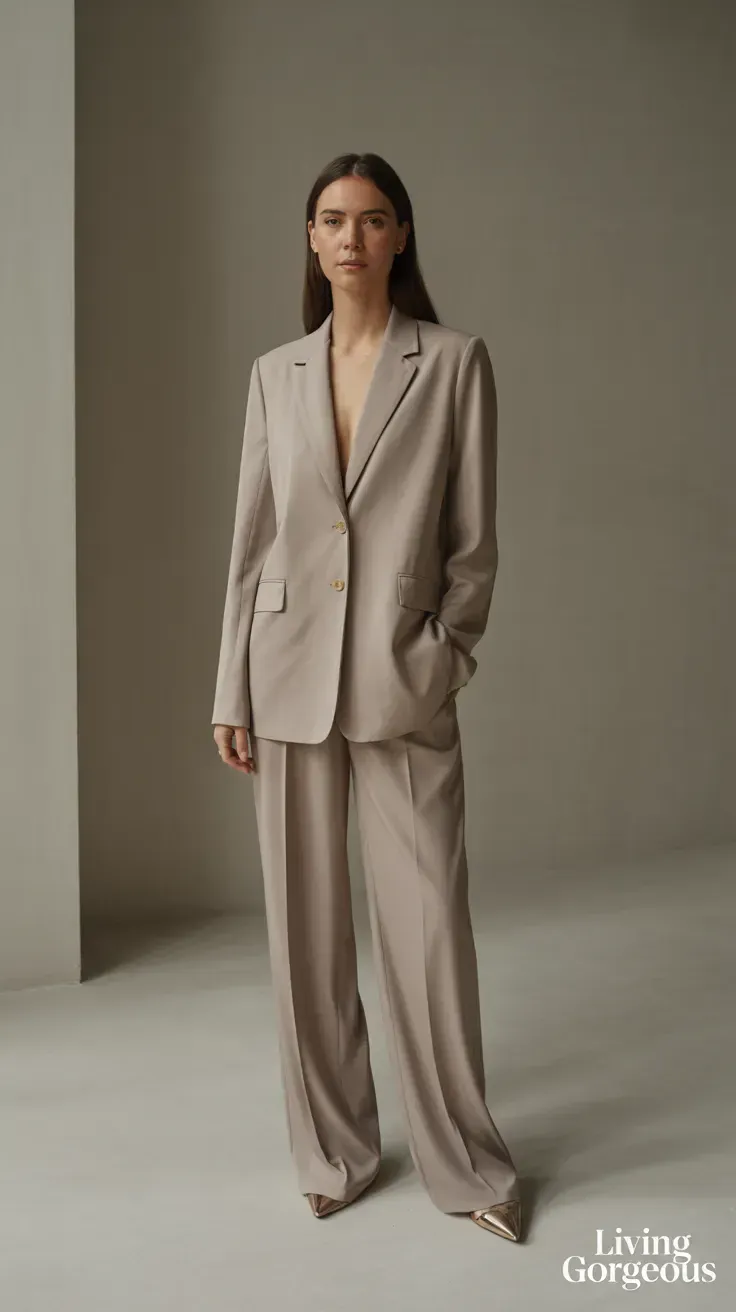
The problem arises when we purchase pieces that belong to a different proportion language than our own — usually because we admire them intellectually, or because they represent a version of ourselves we are working toward rather than the one we currently inhabit. The oversized blazer that looks extraordinary on the editorial pages but makes you feel buried rather than enveloped. The fitted dress that photographs beautifully but restricts your natural stride. These are not failures of the garments. They are mismatches between the garment's proportion logic and yours.
Learning to identify your actual proportion language — as distinct from your aspirational one — is a process of honest self-observation rather than self-criticism. It requires looking at the pieces you reach for repeatedly and asking what they have in common structurally, not just aesthetically.
The Aspirational Garment Problem
Perhaps the most culturally specific dynamic in American fashion consumption is what might be called the aspirational garment problem: the purchase made not for who you are but for who you intend to become. The power suit bought for a career transition not yet made. The vacation dress purchased for a trip not yet planned. The elevated casual piece acquired for a lifestyle that is slightly more leisurely than the one you actually lead.
These pieces are not purchased carelessly. They are purchased with genuine hope and often with considerable thought. But they are designed for a version of your life that exists in the future tense, and the body — which lives entirely in the present — tends to reject them. There is a subtle inauthenticity in wearing clothing that does not match your actual context, and most people feel it even when they cannot articulate it.
This does not mean aspirational dressing has no value. Clothing can and does influence how we feel about ourselves and, by extension, how we move toward the lives we want. But there is a meaningful difference between a piece that gently elevates your current reality and one that belongs to a reality you have not yet built. The former tends to enter the rotation immediately. The latter tends to wait.
Building a Framework for Honest Evaluation
The most practical outcome of understanding fit psychology and proportion relationships is the ability to evaluate a potential purchase with greater clarity before it enters your wardrobe. A few questions worth asking in any dressing room:
Does this feel settled on my body, or does it feel like I am managing it? The difference between these two experiences is usually apparent within the first five minutes of wearing something.
Does this belong to my actual proportion language, or do I admire it from the outside? Admiration and alignment are not the same thing, and conflating them is responsible for a significant portion of unworn wardrobes.
Am I buying this for my current life or a projected one? If the answer is the latter, the question becomes: how close is that projected life to the one I am actually living today?
And finally, the most revealing question of all: Can I imagine wearing this on an ordinary Tuesday? The pieces that belong to your style identity do not require special occasions to justify themselves. They are simply part of how you show up — on unremarkable days, in familiar places, as the person you already are.
The confidence that comes from dressing in genuine alignment with your identity is not manufactured through effort or willpower. It is the natural result of wearing clothes that were chosen honestly — for your body, your life, and your actual self rather than an edited version of it. That is not a small thing. In many ways, it is the whole point.