Designing for Others, Discovering Yourself: What a Client's Wardrobe Teaches You About Your Own

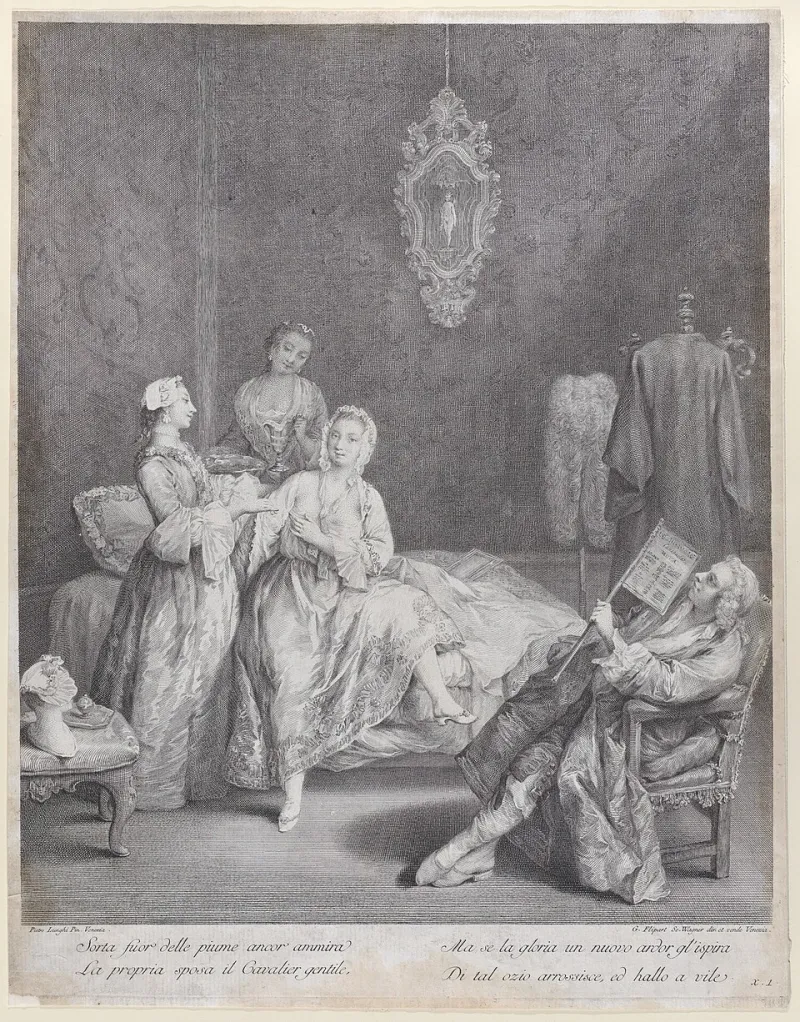
Photo: Internet Archive Book Images, No restrictions, via Wikimedia Commons
There is a particular kind of silence that settles over a room when a client opens her closet for the first time. She steps back, arms crossed, waiting for your assessment. You are supposed to be the expert. You are supposed to see clearly what she cannot. And you do — but what nobody tells you is that in the act of seeing her clearly, you begin to see yourself in ways you were not entirely prepared for.
This is the quiet paradox at the heart of designing for others.
The Moment the Mirror Turns
When a client describes what she wants from her wardrobe, she rarely speaks in the language of garments. She speaks in feelings. She wants to walk into a room and feel grounded. She wants her clothes to stop being a source of morning anxiety. She wants to look like herself — or, more precisely, like the version of herself she has been meaning to become.
Listening to these requests requires a kind of deep attention that goes beyond fabric and silhouette. You are being asked to translate an emotional aspiration into a physical reality. And somewhere in that translation process, you begin to notice which of her desires resonate with something unresolved in your own wardrobe narrative.
Perhaps she confesses that she has been holding on to a dozen pieces she never wears because getting rid of them would feel like admitting something. You nod with professional empathy. Then you go home and stand in front of your own closet and recognize, with some discomfort, the exact same row of unworn garments hanging in the back.
Designing for others has a way of doing that. It removes the convenient fog of personal habit and forces clarity.
Articulating the 'Why' Forces You to Own It
One of the most demanding aspects of working with a client is that you must be able to explain your recommendations. It is not sufficient to say that a structured blazer is the right choice. You must explain why — why for her body, her lifestyle, her aesthetic ambitions, the particular story she is trying to tell with her appearance.
This requirement to articulate is, in the long run, a gift. Because the moment you begin explaining principles out loud, you realize which ones you have been applying to your own wardrobe with consistency and which ones you have been quietly ignoring.
I have found myself telling a client that she should stop buying pieces she loves in isolation and start asking whether each item serves the larger composition of her wardrobe. It is sound advice. It is also advice I have needed to hear myself, delivered back to me in my own voice, from across a fitting room.
There is something almost comedic about the experience — and something genuinely instructive. When you must defend a principle to someone else, you either discover it holds or you discover it was never as solid as you assumed.
The Blind Spots We Carry Into Other People's Closets
Every designer brings her own aesthetic biases into the room. This is not a flaw; it is, in part, what makes a point of view valuable. But it becomes a liability the moment those biases go unexamined.
I have caught myself steering a client away from a bold color simply because it falls outside my own personal palette — not because it was wrong for her. I have overweighted structure and underweighted ease in recommendations for women whose lives demanded far more flexibility than my own. These are not grand failures, but they are telling ones. They reveal the places where I have confused my preferences with universal truths.
Working with clients whose lives, bodies, and identities differ significantly from my own has been one of the most effective forms of continuing education available to me. A woman who works long hours in a demanding professional environment and then needs to transition seamlessly into an evening social life is not solving the same equation I solve every day. Her wardrobe math is different. Meeting her where she is requires me to set down my assumptions and pick up her reality instead.
In doing so, I return to my own wardrobe with a more honest eye. I ask different questions. I challenge conclusions I had previously treated as settled.
What a Friend's Wardrobe Reveals That a Client's Cannot
Working with friends and family members introduces a different kind of intimacy — and a different kind of difficulty. There is no professional distance to rely on. When a close friend asks you to help her figure out why she never feels comfortable in her own clothes, she is not just asking about fabric and fit. She is asking you to witness something vulnerable.
And in witnessing it, you find yourself reflecting on your own vulnerabilities with unusual honesty. Why do you always reach for the same three combinations on mornings when you feel uncertain? What are the garments you wear when you need to feel capable, and what does it mean that you need them so frequently? Why does a certain silhouette feel like armor, and is that something to embrace or examine?
Friends hold a mirror at an angle that clients cannot. They know too much of your history to let you perform authority without occasionally calling you on it.
The Designer's Own Wardrobe as an Ongoing Conversation
What I have come to understand, after years of designing for others and learning from every one of those experiences, is that a wardrobe is never a finished project. It is a conversation — one that continues to evolve as the person wearing the clothes continues to evolve.
Designing for others has taught me to hold my own wardrobe more lightly. Not carelessly, but without the rigidity that comes from treating past decisions as permanent definitions. The client who needed to let go of pieces that no longer served her reminded me that I, too, am allowed to change my mind. The friend who discovered a color she had never considered reminded me that certainty can be a form of limitation.
Every wardrobe I have been invited into has left something behind in my own. A question I had not thought to ask. A principle I had been applying too narrowly. A permission I had not yet given myself.
This is, perhaps, the most honest thing I can say about what it means to design for others: it is not a one-directional act of expertise. It is a reciprocal education. You bring your knowledge and your eye and your experience. And in return, if you are paying attention, you receive something more valuable — a clearer, more honest understanding of your own relationship with the clothes you choose to wear and the identity you are, always, in the process of designing.