The Fitting Room Confession: What a Tailor Sees That a Mirror Never Will
Every designer I know keeps a tailor on speed dial. Not because we cannot sew, but because we understand something the average shopper does not: the garment you buy is only a draft. The garment you wear—the one that changes how you carry yourself through a room—is made in the alteration appointment.
And yet, for most American women, the tailor's fitting room is a source of quiet dread. It is the place where the number on the tag gets read aloud, where the pin marks map the distance between your body as it is and the body the pattern was drafted for. It is, in my experience, the most honest hour in fashion. We should treat it that way.
Vanity Sizing Has Lied to You. The Tape Measure Won't.
Let us begin with the uncomfortable truth: the size on your label is a marketing invention, not a measurement. American brands have spent decades quietly shifting their sizing downward—what was a size 12 in 1970 might be labeled an 8 today—precisely so that shoppers feel flattered rather than fitted. This practice, known as vanity sizing, has produced generations of women who know their label but not their body.
Then you sit down with a tailor, and the arithmetic ends. A tailor does not care whether you are a 4 or a 14. A tailor cares that your right shoulder sits a quarter-inch lower than your left, that your waist-to-hip ratio falls outside the standard block, that the sleeve pitch of a ready-to-wear jacket was never designed for arms that actually move. The tape measure is neutral. It has no opinion about your body; it simply reports where the garment and the person diverge.
That neutrality is precisely what makes the appointment feel exposing. You are not being judged—you are being seen, in measurements, which is a form of seeing most of us have never experienced.
What Actually Happens at a First Appointment
If you have never taken a garment in for alterations, here is what to expect, so the unfamiliarity does not keep you away.
You will put the garment on over your clothes. Come dressed in something close-fitting and in the undergarments you would normally wear with the piece in question. Shapewear, particular bras, and specific heels change the geometry entirely—bring them if the garment requires them.
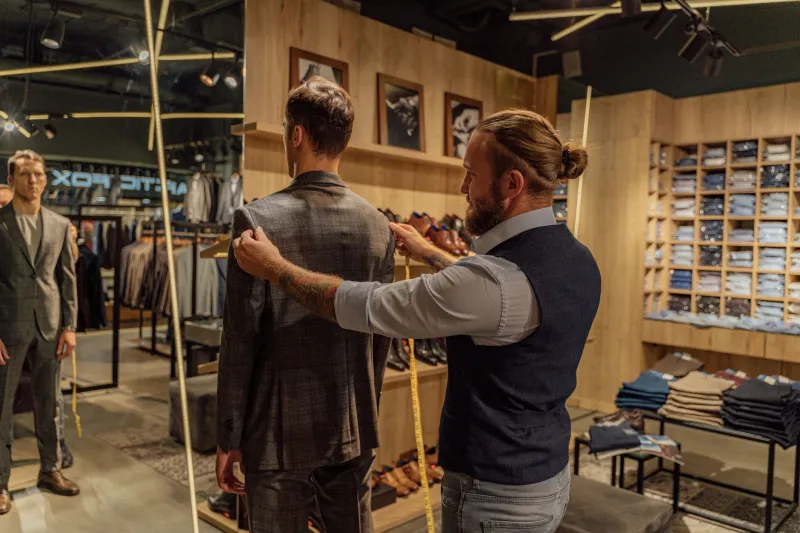
The tailor will pin, chalk, and ask you to move. Expect to be turned, asked to raise your arms, sit, and walk a few steps. A good tailor is not fitting a mannequin; they are fitting a life. If they never ask you to move, find another tailor.
You will discuss the garment's potential honestly. This is the part that surprises people. A skilled alterations professional will sometimes tell you not to proceed—that a jacket's shoulders are too far gone to fix economically, or that taking in a dress will distort its seaming. This candor is a gift. Retail sales associates are paid to sell you the garment; tailors are paid to make it work.
You will get a quote and a timeline. Hems typically run $15 to $40, taking in a dress $30 to $60, reshaping a jacket $75 to $150 or more depending on construction. Allow a week to two for most work; complex tailoring takes longer.
Which Garments Deserve the Investment
Not every piece justifies the expense. As a rule of design, alterations should follow quality, not precede it.
Worth every dollar: blazers and structured jackets, where shoulder fit determines everything; wool trousers and denim you intend to wear weekly; evening wear and occasion dresses; any natural-fiber garment with generous seam allowances; coats, which are the most visible garments you own.
Usually not worth it: fast-fashion pieces with minimal seam allowance, anything with elaborate construction at the shoulder, and garments whose fabric cannot survive being re-stitched. A $25 dress does not need a $30 alteration. Let it go.
The arithmetic that matters is proportional. A $40 hem on a $400 jacket is a rounding error that transforms the entire piece into something that reads as made-for-you—what the industry calls couture fit, achieved for a tenth of couture money. The same $40 spent on a $40 dress doubles its cost for marginal gain. Spend where the foundation is sound.
Why the Appointment Is Worth the Vulnerability
Here is what I tell clients who hesitate: the discomfort of the fitting room is finite, but the confidence of a correct fit compounds daily. A garment altered to your actual body changes your posture, your pace, your willingness to be photographed. You stop adjusting, tugging, and apologizing with your hands.
There is also a quieter benefit. Tailoring is an act of sustainability that no one talks about. Every garment fitted properly is a garment kept for years instead of seasons. In a country where the average piece of clothing is worn a handful of times before disposal, the tailor's chair is one of the last outposts of longevity in American fashion.
So yes, the appointment requires a small confrontation—with real numbers, with a real body, with the gap between what the tag promised and what the mirror shows. But that confrontation is the beginning of a wardrobe that finally belongs to you. The label was never telling the truth anyway. The tailor will.