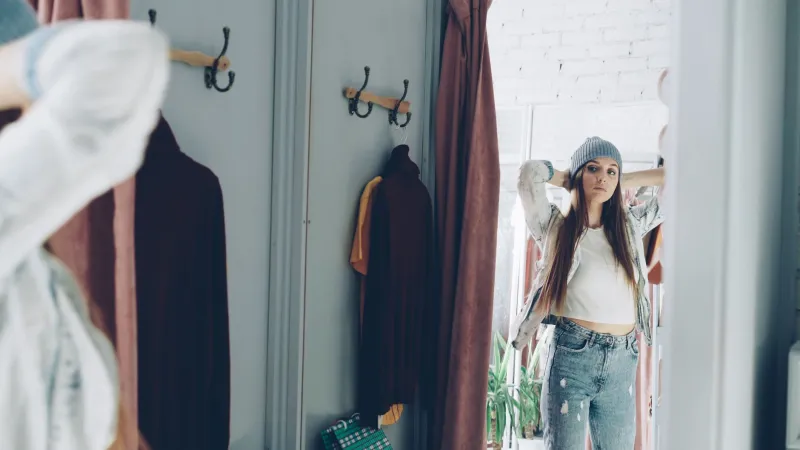
Neither Office nor Living Room: Building a Wardrobe for the Spaces In Between

Photo by Photo by Brooke Cagle on Unsplash on Unsplash
There is a gap in nearly every American wardrobe, and most of us have never named it. We own clothes for work and clothes for home. We own what we wear to be productive and what we wear to disappear. But the hours we spend in between — the Saturday afternoon at the coffee shop, the evening gallery opening, the long wait at the airport gate — those hours are often dressed by accident.
As a designer, I find this gap fascinating, because the in-between spaces are where many of us are most ourselves. Not performing for colleagues, not dissolving into comfort. Simply present. And presence, I would argue, is its own dress code.
The Third Place Deserves Its Own Design Logic
Sociologist Ray Oldenburg coined the term "third place" decades ago to describe the public spaces that aren't home and aren't work — the barbershop, the diner, the neighborhood bookstore. In American life, these spaces have multiplied and evolved: the climbing gym, the independent cinema, the farmers market, the co-working café where nobody is actually working.
Yet our clothing categories never caught up. We stretch workwear into these spaces and feel stiff. We stretch loungewear into them and feel invisible. The result is a wardrobe that serves two masters and serves neither well in the hours between them.
What the third place requires is a third category: pieces engineered for neither productivity nor pure comfort, but for being seen — gently, casually, without stakes. This is clothing for the version of you that exists when nobody is evaluating you.
What "Presence Dressing" Actually Looks Like
Presence dressing is not dressing up. That distinction matters. Dressing up implies an audience with expectations. Presence dressing implies only that you showed up as a person of some interior life. The practical translation:
Texture over structure. A third place garment should be interesting to the eye and easy on the body. A heavyweight knit in an unexpected shade. A wide-leg trouser in a soft tencel. Structure reads as obligation; texture reads as choice.
One deliberate detail. In spaces where nobody is required to notice you, a single point of intention — a sculptural collar, an unusual hem, a bag in a color that has no business working but does — signals that you dressed for yourself. This echoes a principle I return to often: one unexpected element does more than ten coordinated ones.
Shoes that commit. Nothing reveals a wardrobe's neglected category faster than footwear. If your weekends are lived in third places, your shoes should be built for walking a mile of city blocks and standing in a gallery for an hour — while still saying something beyond "sensible."
Layers that travel. The third place is thermally unpredictable. Air-conditioned cafés, breezy patios, overheated terminals. A well-designed third layer — a shacket, a long cardigan, a chore coat — is the workhorse of this category because it solves a real problem while completing the composition.
Why Dressing for These Spaces Changes Them
Here is the part I did not fully appreciate until I began observing clients' wardrobes closely: the way you dress for a space changes how you occupy it. Arrive at a museum in gym clothes and you move through it quickly, apologetically. Arrive in something you chose that morning with care, and you linger. You strike up conversations. You sit down and stay.
This is not superstition; it is feedback. Clothing shapes posture, and posture shapes experience. A wardrobe built only for work and rest quietly shrinks your life into those two modes. A wardrobe that includes the in-between gives you permission to loiter with dignity — to be a regular somewhere, which is one of the quiet luxuries of adult life.
Building the Category Into Your Closet
You do not need a second wardrobe. You need perhaps six to eight pieces that belong to no other category, identified by a simple test: could I wear this to a casual workplace? Could I wear it to the couch? If the answer to both is no — if the piece exists only for the world in between — it belongs here.
Start with one. A jacket is the natural entry point because it transforms everything beneath it. Add the trousers that make errands feel like occasions. Then the knit, the bag, the shoes. Within a season, the category builds itself, because you will notice how often you reach for it.
The third place wardrobe is, ultimately, a small act of design optimism: the belief that the unstructured hours — the ones with no meeting, no obligation, no audience — are worth dressing for. They are, after all, where most of life actually happens.