The Mirror Doesn't Lie: What a Fitting Room Moment Reveals About the Life You're Actually Living
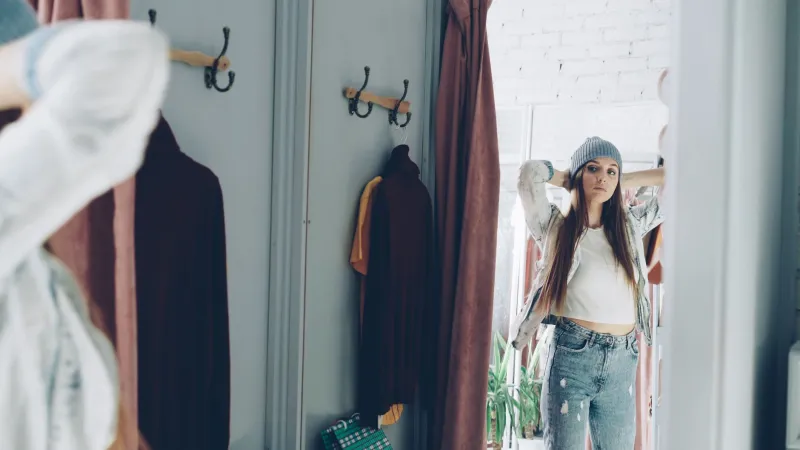
There is a particular silence that falls in a fitting room. The curtain draws, the fluorescent light hums, and suddenly it is just you, a garment, and the truth. In fifteen years of working with clients—from New York executives to California creatives—I have come to believe that the fitting room is the most honest mirror in fashion. Not because it shows us our bodies, but because it shows us our lives.
The Fitting Room as a Diagnostic Tool
When a client steps out of a fitting room and hesitates, I rarely ask whether the dress fits. I ask a different question: Where would you wear this?
The answer is revealing. More often than not, there is a pause—a searching look. The garment is beautiful, the size is correct, and yet the woman standing in it cannot locate the life that contains it. This is the moment I find most valuable as a designer. Not the triumphant reveal, but the hesitation. Because hesitation tells us something the rack never could: there is a gap between the wardrobe she is building and the days she is actually living.
Three Women, Three Confessions
Consider a few composite portraits drawn from my own practice.
The first client, a attorney in Chicago, kept trying on sharply tailored blazers—the kind she had worn for a decade of corporate life. They fit impeccably. But she had recently transitioned to remote consulting work, and standing in the mirror, she looked like a photograph of her former self. Her wardrobe was loyal to a life she had already left.
The second, a mother of three in suburban New Jersey, kept gravitating toward the same category: soft, forgiving, invisible clothing. When I asked her to try a structured coat—something with a shoulder, a presence—she laughed and said she had nowhere to wear it. But as she stood taller in the mirror, her posture changed. The confession wasn't about the coat. It was about how long she had dressed as though her visibility no longer mattered.
The third client was the opposite: a young designer in Los Angeles who tried on only fantasy pieces—sheer, dramatic, unwearable for her actual days of studio work and grocery runs. Her fitting room confessions revealed a different gap: a wardrobe of aspirations with no bridge to her Tuesdays.
Clothes We Love Versus Clothes We Live In
Every wardrobe contains two populations: the clothes we love and the clothes we actually live in. The fitting room is where these two groups collide.
The clothes we love are often tied to an imagined self—thinner, busier, more social, more daring. The clothes we live in answer to reality: the commute, the school pickup line, the back-to-back video calls, the long American distances between errands. When a fitting room purchase will only ever serve the imagined self, it does not become part of a wardrobe. It becomes part of a museum.
My rule is simple, and I offer it to every client: a piece earns its place only if you can name the specific day it will serve. Not an occasion. A day. If you cannot picture the Tuesday morning it belongs to, you are not buying a garment—you are renting a fantasy.
Reading Your Own Fitting Room Honestly
You do not need a designer at your side to have this revelation. You need only a method. Next time you try something on, run it through three quiet questions:
First: Do I recognize the person in the mirror? Not the body—the person. If the reflection feels like a costume or a memory, take note. Outdated self-perception is one of the most common things a fitting room exposes.
Second: Can I move through my real day in this? Sit, reach, walk, climb stairs. American life is not lived standing still in good lighting. A garment that cannot accommodate your actual movements, however lovely, will not survive contact with your calendar.
Third: Am I dressing for the life I have or the life I'm postponing? There is nothing wrong with aspiration—but aspiration without integration breeds a closet full of tags still attached.
The Honest Mirror as a Starting Point
I understand the temptation to avoid the fitting room entirely, to order online and return quietly, sparing ourselves the confrontation. But the confrontation is the point. The fitting room asks us to reconcile who we believe we are with who we currently are—and that reconciliation, uncomfortable as it may be, is where authentic style begins.
At its best, fashion is not escapism. It is correspondence with your own life, written daily in fabric. The fitting room is simply where you read the letter aloud.
So the next time you draw that curtain, listen for the pause. The hesitation in the mirror is not a flaw in the garment. It is information—and often, it is the beginning of a wardrobe that finally, truthfully, fits.